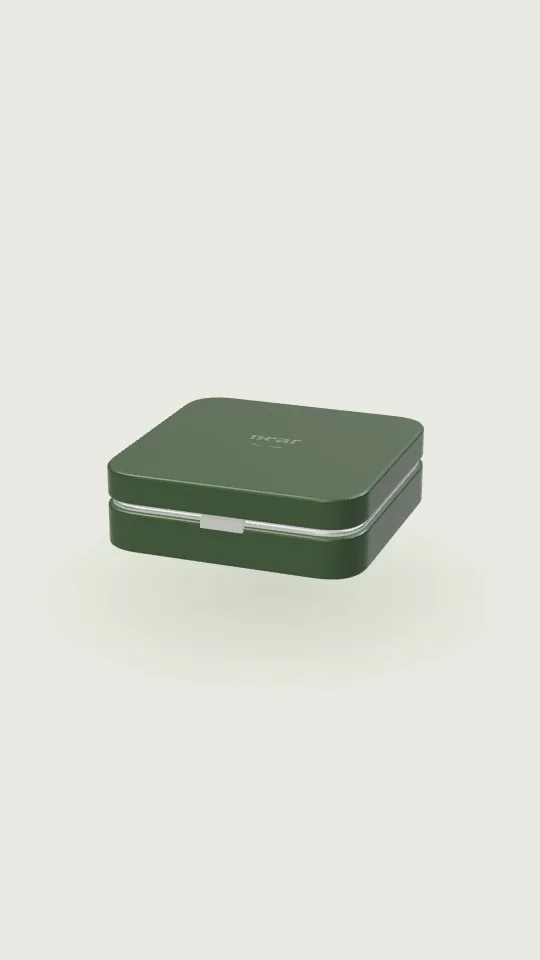
A motion brief you can watch
A camera instruction can be difficult to communicate in a paragraph. A basic Three.js scene makes the intended framing and timing visible: a rotation, a hinge opening, a material close-up, and an orbit back to a final product view.
The near visual study uses a 12-second continuous move. The basic scene is a motion reference, not the intended final rendering quality.
References guide; they do not guarantee
The motion study is supplied alongside approved product images to guide the generated shot. The result still has to be checked for drift in shape, framing, mechanics, and timing. A reference video does not make an AI output frame-accurate.
That difference is worth showing. The portfolio synchronises the finished visual and the motion study in a draggable comparison, with both complete films also available on the case page.
Smoothness can matter more than exact matching
A later Three.js reconstruction follows the generated film. Smoothing the path allows some framing difference in exchange for more stable movement. Hard-following every sampled position can introduce a distracting wobble.
This is a useful production choice: decide which parts need precision, and which parts benefit from visual continuity. Judge the result at normal playback speed as well as on individual frames.